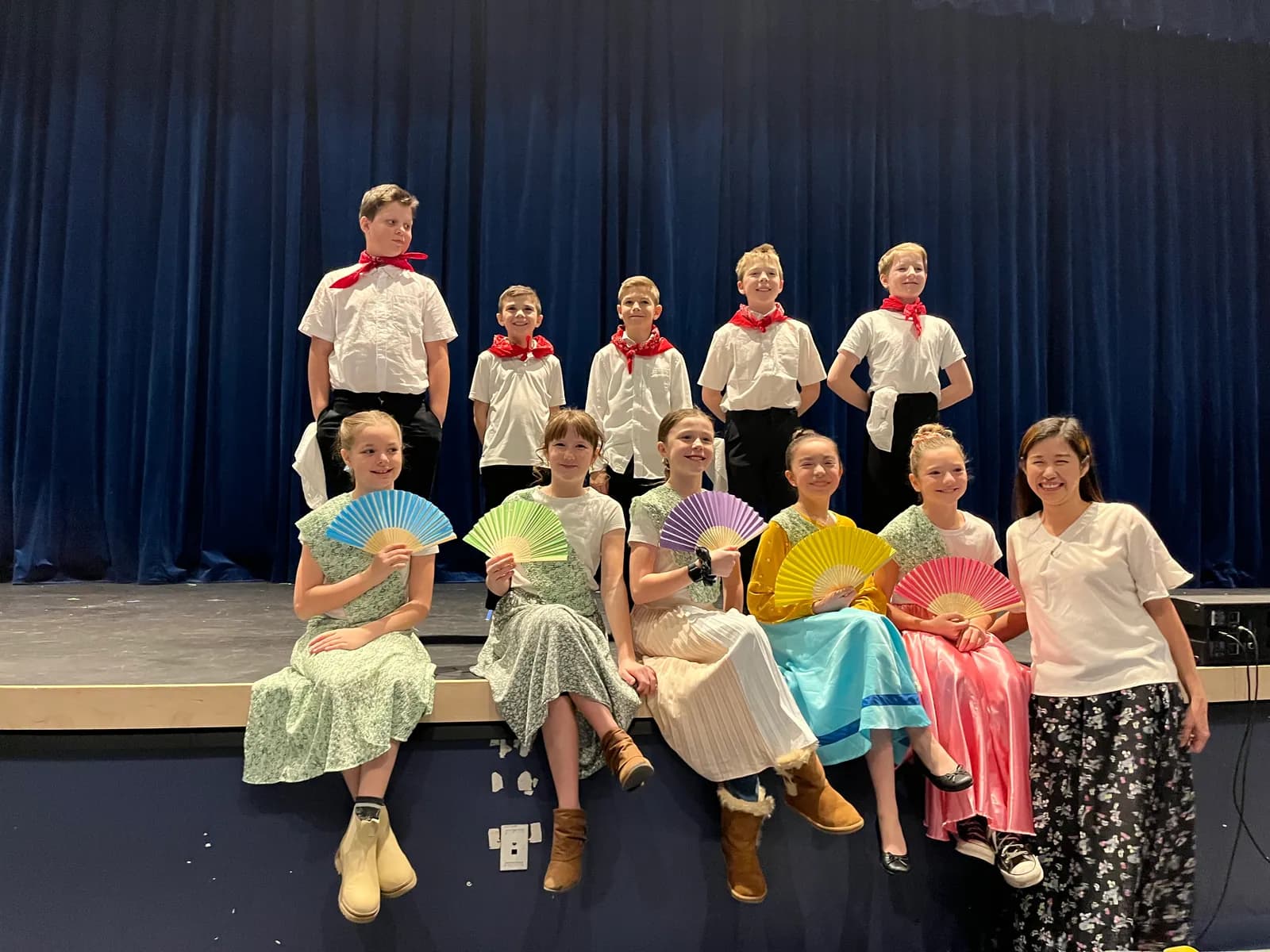
What students learn at each grade level, from Pre-K through graduation: a values-centered curriculum that builds knowledge and character.
Elementary: Pre-K through 4th Grade
Reading, mathematics, science, social studies, the arts and technology, building knowledge and character from the very first day.
Pre-K / Kindergarten
Our youngest learners build a strong foundation through play-based and hands-on experiences that foster curiosity, creativity, and a love of learning rooted in Gospel principles.
Reading & Phonics
Students are introduced to letter recognition, beginning sounds, rhyming words, and simple sight words. Through stories, songs, and daily scripture time, children develop early literacy skills and a love for reading.
Mathematics
Foundational number sense is taught through counting, sorting, patterns, shapes, and basic addition and subtraction concepts. Hands-on manipulatives and real-world activities make abstract ideas concrete and engaging.
Science & Discovery
Young students explore the world around them through observation and simple experiments. Topics include weather, seasons, the five senses, plants and animals, and the wonders of God's creation.
Social & Emotional Learning
Children learn classroom etiquette, how to be a good friend, sharing, taking turns, and understanding emotions. Lessons are built around Gospel values such as kindness, service, and respect for others.
Art, Music & Movement
Creative expression is encouraged through painting, drawing, singing, rhythm activities, and physical movement. These classes help develop fine and gross motor skills while nurturing a love for the arts.
Computer Basics
Students gain familiarity with tablets and computers through age-appropriate educational apps that reinforce reading, math, and Gospel-centered learning in an interactive format.
Grades 1–2
First and second graders deepen core academic skills through structured lessons and Gospel-integrated instruction that encourages independent thinking and a growing testimony.
Reading
Phonics instruction covers short and long vowels, blends, vowel teams, sight words, compound words, syllables, sentence construction, and foundational grammar. Students progress from simple readers to chapter books, with daily scripture study woven into the reading program.
Mathematics
Skills include counting into the thousands, skip counting, odd and even numbers, place value, addition and subtraction with regrouping up to three digits, basic geometry, measurement, time, money, fractions, Roman numerals, tally marks, graphs, and an introduction to multiplication and division.
Science
Students study the Creation, introductory geology, biomes, simple chemistry and physics experiments, biological sciences including animal habitats, insect life cycles, health practices, stars and planets, and ocean life — all taught with a Gospel-centered perspective.
Social Studies
Coursework addresses classroom etiquette, the importance of families, the founding of America, Pilgrims and pioneers, holidays and their origins, freedom and law, world geography including oceans and continents, LDS members around the world, and the practice of service.
Art, Music, Drama & P.E.
Hands-on classes help each child develop a love for and appreciation of the arts. Students participate in drawing, painting, music, dramatic play, and physical education. These subjects focus on personal growth rather than formal grading.
Computer Skills
Students build basic computer and tablet proficiency through educational apps that reinforce reading, math, science, and Gospel-related content in an interactive, engaging environment.
Grades 3–4
Third and fourth graders expand their abilities through more rigorous academics, deeper critical thinking, and continued spiritual growth as they prepare for the upper-elementary years.
Reading & Language Arts
Students refine comprehension strategies, vocabulary development, fluent reading, and written expression. Coursework includes book reports, creative writing, grammar and punctuation, and continued daily scripture study to strengthen both literacy and testimony.
Mathematics
Instruction advances to multi-digit multiplication and division, fractions and decimals, measurement and data analysis, geometry concepts, problem-solving strategies, and an introduction to pre-algebraic thinking. Students build mathematical reasoning and confidence.
Science
Investigations cover earth science, ecosystems, the water cycle, weather systems, states of matter, simple machines, the human body, and structured experiments that strengthen the scientific method — all connected to Gospel teachings on creation and stewardship.
Social Studies & History
Students study Utah and U.S. history, state and national government, map skills, cultural geography, Native American history, westward expansion, and community responsibility. Gospel principles of freedom, agency, and service are woven throughout.
Art, Music, Drama & P.E.
Students explore artistic techniques, musical theory and performance, theatrical production, and structured physical fitness. These classes cultivate creativity, teamwork, and self-expression without formal grading.
Technology
Students develop typing skills, learn basic digital research methods, and use educational software to support core subject learning. Responsible technology use and online safety are also introduced.
Academy: Grades 5 through 12
A rigorous, Gospel-centered curriculum built on multi-year rotations, developing mastery in science, language arts, history and mathematics through graduation.
Grades 5–6
Liahona's 5th and 6th grade program introduces students to the power of Restoration Education. Gospel principles are integrated throughout the day, beginning with scripture discussion each morning. The curriculum emphasizes higher-order thinking, strong writing skills, and hands-on learning across every subject.
Science
Students explore the natural world through a two-year rotating curriculum that balances life and physical sciences, grounded in reverence for God's creation.
Year 1 — Biology
The Creation, cells and cell structure, the biosphere, food webs and ecosystems, plant biology, ornithology, aquatic mammals, and systems of the human body.
Year 2 — Physics
Measurement and the scientific method, notable physicists, states of matter, mechanics and motion, forms of energy, electricity, magnetism, and an introduction to DNA.
History
A two-year rotation covering American and world civilizations, connecting historical events to Gospel principles of liberty, agency, and divine purpose.
Year 1 — American History
The age of exploration through the Civil Rights Movement, including states and capitals, colonial America, the Revolutionary and Civil Wars, and westward expansion. Also covers prehistoric, ancient, and medieval world history.
Year 2 — World History
From the ancient Sumerians through the Cold War era, spanning major civilizations, empires, religious movements, global conflicts, and the forces that shaped the modern world.
Writing
Daily writing instruction develops sentence structure, grammar, composition, and creative expression across multiple genres.
Year 1 & Year 2
Students practice persuasive, creative, and informational writing. Lessons focus on paragraph construction, essay development, grammar conventions, and editing skills — building confident, capable writers prepared for secondary coursework.
Reading
Students engage with a diverse range of literature including informational texts, fantasy, historical fiction, and nonfiction. Featured works include selections from both classic and contemporary authors.
Literature & Poetry
Reading selections span novels, short stories, and excerpts from celebrated works. Poetry study includes diamonte, cinquain, metaphor, simile, acrostic, couplet, and definition poem forms — strengthening comprehension, vocabulary, and literary analysis.
Art & Music Appreciation
Students study masterworks and develop cultural literacy through the visual and performing arts.
Visual Arts
Students study the techniques and legacy of artists including Van Gogh, Renoir, Monet, Manet, Seurat, and notable modern artists of the 19th and 20th centuries.
Music
Music appreciation covers composers and performers such as Beethoven, Mozart, Bach, Tchaikovsky, Bizet, Louis Armstrong, Elvis Presley, The Beatles, The Beach Boys, and the Tabernacle Choir at Temple Square.
Grades 7–12
Grades 7 through 12 follow a four-year rotating curriculum that deepens in rigor with each cycle. Students in grades 7–8 and 9–12 study the same subject areas simultaneously, with content and expectations scaled to their level. Gospel perspectives and scriptural connections are woven into every discipline.
Science
The study of science at Liahona is designed to foster a greater reverence and testimony of God's handiwork. Coursework alternates between life and physical sciences on a four-year rotation.
Year 1
Grades 9–12: Physics — the study of matter, energy, and their interactions. Grades 7–8: Earth Science — atmosphere, hydrosphere, weather systems, Earth's interior, motion and Newton's Laws, gravity, and astrophysics with hands-on experiments.
Year 2
Grades 9–12: Biology — the study of living organisms including plants, animals, and humans; classification, behavior, the Word of Wisdom, and environmental stewardship. Grades 7–8: Life Science — foundational study of living organisms and biological systems.
Year 3
Grades 9–12: Earth Science — geology, oceanography, meteorology, and astronomy with a focus on processes that affect people and communities. Grades 7–8: Earth Science — continued study of atmospheric and geological systems.
Year 4
Grades 9–12: Chemistry — atoms, atomic structure, element bonding, the Periodic Table, and organized problem-solving through regular lab experiments. Grades 7–8: Life Science — deeper exploration of biological organisms and systems.
Language Arts
A classical, skills-based approach concentrating on critical thinking in reading and writing. Students produce an average of four portfolio-quality papers per year and read approximately six classic texts annually, including the scriptures. Activities include discussion, note-taking, vocabulary building, grammar modeling, essay writing, and speech exercises.
Year 1 — Genre Studies / Liahona Grammar Vol. 1
Students explore different literary forms — fiction, biography, essay, discourse, and narrative versus expository writing. Formalism and comparative literature techniques examine how form shapes meaning.
Study of archetypes, themes, and symbols through the Old Testament, classic novels, epic poems, and drama. Students examine the heroic cycle, the concept of freedom, and the plan of salvation, learning to discern uplifting literature.
How writing is constructed to be compelling and persuasive. Uses the Book of Mormon, notable speeches, essays, and novellas to develop critical thinking and rhetorical writing skills.
Year 4 — History of Language / Liahona Grammar Vol. 4
Analysis of how historical events and cultural shifts shaped literature and language. Studies the New Testament and poetry while exploring grammar conventions, their exceptions, and effective use of language. Grades 7–8 alternate between Years 1 and 2.
History
History instruction centers on the principle that the Constitution was established by divine inspiration and should be upheld for the rights and privileges of all. Students analyze primary-source documents alongside commentary from prophets and apostles.
Year 1 — American Government & Civics
Studies the divine origin of the Constitution and the government it established. Students analyze original documents from Reformation thinkers through the American founders — Wycliffe, Knox, Huss, Jefferson, Washington, and Franklin — learning to become defenders of constitutional principles.
Year 2 — American History I (Pre-Discovery–1865)
Primary documents trace the personalities and events that created and preserved the nation: Native American civilizations, Viking expeditions, colonial establishment, the Revolution, westward expansion, and the Civil War. Latter-day Saint history is interwoven throughout.
Year 3 — American History II (1860–Present)
From the close of the Civil War to the 21st century — Reconstruction, both World Wars, the Great Depression, Korea, Vietnam, the Cold War, and September 11. Includes scriptural prophecies about the latter days and ongoing Church history.
Year 4 — World Civilizations & Geography
Ancient Israel through the European Reformation: the Roman and Byzantine empires, the Crusades, the Middle Ages, the rise of Islam, and the breaking away from Catholicism. Explores how European philosophy influenced America's founding fathers.
Mathematics
Liahona uses the Saxon Math incremental curriculum, where concepts are introduced in small steps and reinforced through continual review. Students are placed according to concept mastery rather than age, and may repeat a course until they demonstrate 80% mastery or higher. Math develops the problem-solving and critical-thinking skills that serve students for life.
Course Sequence
Math 5/4 → Math 6/5 → Math 7/6 → Math 8/7 → Pre-Algebra → Algebra 1 → Geometry / Algebra 2 → Pre-Calculus → Calculus. Several courses are also available through Online Education for flexible scheduling.